Palaeolexicon
Word study tool of ancient languages
Welcome to Palaeolexicon!
Hittite priestPalaeolexicon is a word study tool for ancient languages of the Balkans and Anatolia, such as Hittite, Lydian, Greek, Phrygian, Thracian etc.

At its current state, it covers the following languages:
  • Mycenaean Greek (in Linear B)
  • Cypriot (Syllabic script)
  • Phrygian
  • Cappadocian
  • Carian
  • Lydian
  • Hattic
  • Thracian (reconstructed)


Update September 29th 2012 - The Palaeolexicon Blog!!!
It was about time to do something about the absence of a proper article/blog system on this site. Since version 2 of Palaeolexicon is going to take a while, it felt like there was a need for an immediate solution for this issue. There you go then! Enjoy the Palaeolexicon blog!

http://palaeolexicon.blogspot.se


Update September 1st 2012
The Hattic dictionary is now available!

There's some more work to do, but most of the words are there with references. Give us some time for the article about the Hattic language; we will publish it as soon as possible.


Update June 29th 2012
You think Palaeolexicon is put on ice? Maybe it looks like not much is happening, but this is not the case. Plans for a new improved version with many innovations do exist! However, it is better to spend some time making the best out of those new ideas, instead of releasing something quickly, just for the sake of it.

Meanwhile, the databases are enriched with more words being linked to each other. There's also a thought of exposing words belonging to incompleted dictionaries while doing a search. For instance there's a good number of Hattic and Lycian words hidden back there! Why not make them public?


What about Palaeolexicon version 2?
There are plans for version 2 of this site. The ideas are many such as the creation of word lists by users and tools for better comparison e.g word distance and meaning. No matter what we believe, you probably know better what you want from a site like this. Please send us some feedback and let us know how you are using Palaeolexicon. What do you think would make your experience on this site better?


Update October 4th 2011
Information about the Lydian language is now available in the languages section. Lydian letters have also been added to the Lydian word list. If you can't see them, make sure to have the Aegean font installed.


Update June 11th 2011
In the blog of a regular Palaeolexicon visitor, I noticed that the absence of wildcards was mentioned. Well, actually Palaeolexicon supports wildcards but noone ever mentioned this. So, this is what you can do while using the search engine (wildcards and operators are in bold):

Operators

word1 {or} word2 - Selects records that contain word1 or word2 e.g type: child {or} offspring
word1 {and} word2 - Selects records that contain both word1 and word2 e.g type: god {and} apollo
word1 {near} word2 - Selects records where word1 is near word2 e.g type: god {near} war

Wildcards

You can use ? (questionmark) as a wildcard - e.g type: kow?


Update June 5th 2011
A different project has started in Palaeolexicon. The addition of a 'Cappadocian' dictionary is the latest attempt to trace pre-Hellenic words of the Cappadocian Greek dialect. By carefully isolating words that have no direct connection to Greek, Turkish and Persian, we hope to come as close as possible to what was actually spoken in the region of Cappadocia. Please have a look and contribute with comments. Your help will be vital for this project!


Update May 26th 2011
There's now a full presentation of the Carian language, in the languages section.


Update March 29th 2011
A Lydian dictionary is available at last!

Unfortunately, since the sources on Lydian are few and scattered, the dictionary is still under review. There's a lot of work to be done, until this section can be considered complete. A language description is not yet available, however on the 'Carian front' expect something to pop-up soon.


Update March 20th 2011
The Phrygian dictionary is the most detailed you will find online. Unfortunately, the article about Phrygian was not as concise as it should be and therefore a massive update on the presentation of the Phrygian language has been made. More updates will follow soon, in order to deliver you the absolute source on Phrygian online!


Update January 9th 2001
The Carian dictionary is available at last!

There are no symbol representations of the weird Carian letters yet, but that will be fixed soon! Obviously, the current font is not optimal for the transcription of Carian. Since the site was initially made for displaying simple Latin and Greek characters, unicode characters are unfortunately not shown correctly. There is already a plan for a new enhanced version of Palaeolexicon where everything will be much better e.g (full Unicode support, better searches, searchable inscription index etc).


January 6th 2011 - News from Anatolia
Happy new year everyone!

A great amount of words for the forthcoming Carian dictionary have been processed with full documentation. Expect also a good facelift on the Phrygian dictionary and the information on the Phrygian Language.

Meanwhile, you might want to have a look a the latest sensational news from north-eastern Turkey, where the lecturer of romance philology of Cambridge Ioanna Sitaridou, has discovered the closest living dialect to Hellenistic Koine Greek (4th century BC to 4th century AD). Romeyka, as the language has been called, is a dialect of Greek that preserves an impressive number of ancient Greek grammatical traits, not to be found in modern Greek that has it roots in the post-Hellenistic times, between the 7th and 13th century AD. This discovery will allow the team of Cambridge to study a living sample and understand how Greek has evolved over millennia. Now the question is: are those 5,000 speakers descendants of the Greek settlers that migrated to the area around the 8th and 7th century BC or are they native Anatolians who adopted Greek as their first language during the Hellenistic years? Read the whole article on http://www.research-horizons.cam.ac.uk/features/-p-against-all-odds--archaic-greek-in-a-modern-world--p-.aspx and watch the youtube video about Romeyka on http://www.youtube.com/watch?v=UcAYP4irSyQ.


Update December 13th 2010
The history, prehistory and language of Cyprus has been posted in the 'Languages' section.

There has also been a great progress on the Carian dictionary. A working version of it should be available hopefully before 2011. Lycian and Lydian, have still a lot of work to be done.


Update October 13 2010
A dictionary of Cypriot syllabic script is now available!


Update September 17 2010
If you experienced problems reaching the site was due to a server change. If you now see this message, everything should be ok.


Update September 7 2010
At last, after a long time there's a presentation on the Thracians and the Thracian language.


Update August 8 2010 - Change of plans
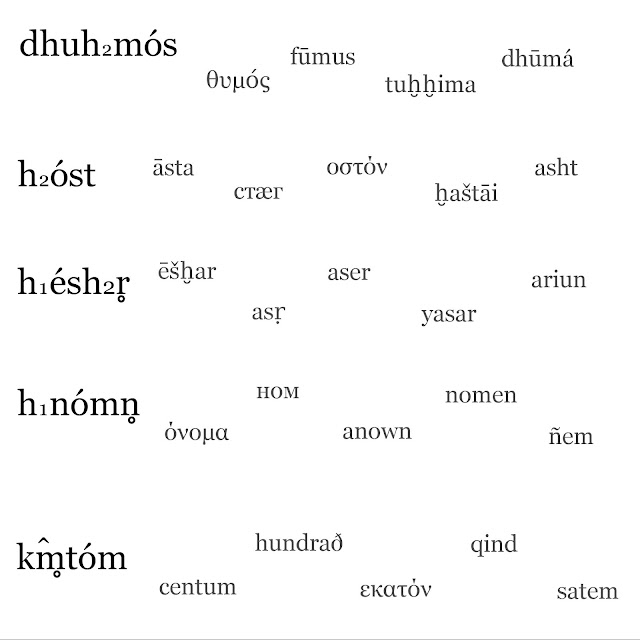
It looks like we're going to give different priorities to languages. In the previous update, we announced that Hittite and Ancient Macedonian will be the next two languages to be available in Palaeolexicon. Right now, a dictionary of Proto-Indo-European is necessary in order to have detailed entries of the PIE roots for the Greek, Phrygian and Thracian languages. You will already notice PIE links in Phrygian.

Meanwhile, Lydian and Lycian dictionaries are being prepared for release. Hittite will have to wait until 2011, while an ancient Macedonian dictionary will be released hopefully before the end 2010.


Update April 7 2010
The PIE roots of words are being updated. This requires a lot of time, but gives a basis for the future creation of a PIE dictionary.


Palaeolexicon is finaly released! (01/03/2010)
Palaeolexicon is released today March 1rst 2010. After 14 intense months of development and data entry, this site is finally online!

Here's a todo list with things that have to be ready soon:
  • Enrichment of Mycenaean personal names
  • Articles section
  • Main article about the Thracian language


Update January 9 2010
We have at last made some major corrections on the user interface. Most of it have been minor and quite invisible bugs but nevertheless important before launching.

  • The Phrygian and Linear B vocabularies have been enriched, new reference languages have been added, amongst them 160 000 Greek words that will be used for referencing further information (e.g See also field of a word).

  • The search engine now present multilingual results in tabs. It does not mix Greek and Phrygian in one grid, but separates them into 2 or more and lets you find easier what you want. Try for example to search for the word 'king' to get a tabbed-view of words in Phrygian and Greek.

  • The site is being optimized for good indexing in search engines and tools for sharing links to other sites are being prepared.

  • People can provide feedback to correct errors or add content, while viewing a word.
Results per page
Default language